| Pages: [1] :: one page |
| Author |
Thread Statistics | Show CCP posts - 0 post(s) |

Sirref Naes
Gallente
Spacial 8 Xchange
   |
Posted - 2010.11.01 17:57:00 -
[1]
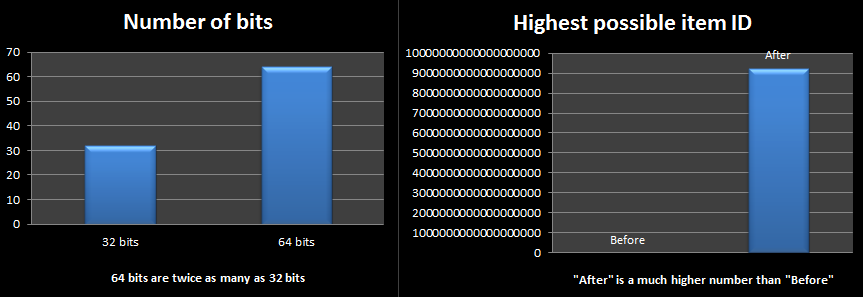
I learned that 64 bits is greater than 32 bits
Here's a graph for you.
[ http://cdn1.eveonline.com/community/devblog/2010/graph5.PNG ]
|

Jovan Geldon
Gallente
Lead Farmers
|
Posted - 2010.11.01 18:03:00 -
[2]
 Originally by: Sirref Naes Originally by: Sirref Naes
64 bits is greater than 32 bits
Pics or it didn't happe-
Oh.
|

JitaPriceChecker2
|
Posted - 2010.11.01 18:04:00 -
[3]
Give me my 5 seconds of life back
|

Cpt Advile
|
Posted - 2010.11.01 18:06:00 -
[4]
that graph isn't clear enough
the confusion angers me... >:l
________________________________
ACXtreme @ deviantart |

Gecko O'Bac
H A V O C
Cascade Imminent
|
Posted - 2010.11.01 18:44:00 -
[5]
Edited by: Gecko O''Bac on 01/11/2010 18:49:31
Just for the sake of arguing I'll say this:
The two graphs must not be considered separately as the objective of the graph was to show that with a 2 times increase of the bits we get a huge increase in available item IDs (that must be unique). Precisely the increase is from 2.147.483.648 (2^31 IDs) to the humongous 9.223.372.036.854.775.808, which is around 4,5 BILLION times increase. Neat, huh?
|

Fulbert
Gallente
|
Posted - 2010.11.01 18:45:00 -
[6]
Edited by: Fulbert on 01/11/2010 18:50:29
Edited by: Fulbert on 01/11/2010 18:49:38
Edited by: Fulbert on 01/11/2010 18:47:19
32 bits : 2^31 = approx 2,1 x 10^9 possible itemIDs
64 bits : 2^63 = approx 9,2 x 10^18 possible itemIDs, so ~10^9 (one billion) times more.
That's why the "Before" rectangle is invisible. It is just 10^9 times smaller... The "after" rectangle is 5 cm long (5 x 10^-2 meters), so the "before" rectangle is 5 x 10^-11 meters long. That's 50 picometers. It is even smaller than an atom!
--------------------------------
Fulbert.
Miner - Industrialist |
Gecko O'Bac
H A V O C
Cascade Imminent
|
Posted - 2010.11.01 18:49:00 -
[7]
Originally by: Fulbert
Edited by: Fulbert on 01/11/2010 18:49:38
Edited by: Fulbert on 01/11/2010 18:47:19
32 bits : 2^31 = approx 2,1 x 10^9 possible itemIDs
64 bits : 2^63 = approx 9,2 x 10^18 possible itemIDs, so ~10^9 (one billion) more.
That's why the "Before" rectangle is invisible. It is just 10^9 times smaller... The "after" rectangle is 5 cm long (5 x 10^-2 meters), so the "before" rectangle is 5 x 10^-11 meters long. That's 50 picometers. It is even smaller than an atom!
You arrived 1 minute too late :P But the size proportion is cool, didn't think about that :D
|

Sidus Isaacs
Gallente
|
Posted - 2010.11.01 19:20:00 -
[8]
Originally by: Fulbert
Edited by: Fulbert on 01/11/2010 18:50:29
Edited by: Fulbert on 01/11/2010 18:49:38
Edited by: Fulbert on 01/11/2010 18:47:19
32 bits : 2^31 = approx 2,1 x 10^9 possible itemIDs
64 bits : 2^63 = approx 9,2 x 10^18 possible itemIDs, so ~10^9 (one billion) times more.
That's why the "Before" rectangle is invisible. It is just 10^9 times smaller... The "after" rectangle is 5 cm long (5 x 10^-2 meters), so the "before" rectangle is 5 x 10^-11 meters long. That's 50 picometers. It is even smaller than an atom!
They should have used a logarithmic scale.
--------------------------------------------------------------------------------
http://desusig.crumplecorn.com/sigs.html |

Alyth
Gallente
The Scope
|
Posted - 2010.11.01 19:28:00 -
[9]
Originally by: Sidus Isaacs
Originally by: Fulbert
Edited by: Fulbert on 01/11/2010 18:50:29
Edited by: Fulbert on 01/11/2010 18:49:38
Edited by: Fulbert on 01/11/2010 18:47:19
32 bits : 2^31 = approx 2,1 x 10^9 possible itemIDs
64 bits : 2^63 = approx 9,2 x 10^18 possible itemIDs, so ~10^9 (one billion) times more.
That's why the "Before" rectangle is invisible. It is just 10^9 times smaller... The "after" rectangle is 5 cm long (5 x 10^-2 meters), so the "before" rectangle is 5 x 10^-11 meters long. That's 50 picometers. It is even smaller than an atom!
They should have used a logarithmic scale.
But this is EVE so it would be a lagarithmic scale, amirite?
...anyone?
...

|

captain foivos
|
Posted - 2010.11.01 19:35:00 -
[10]
Originally by: Alyth
But this is EVE so it would be a lagarithmic scale, amirite?
...anyone?
...
I lol'd.
|

Tuttomenui II
Gallente
Independent Coalition
|
Posted - 2010.11.01 19:35:00 -
[11]
Edited by: Tuttomenui II on 01/11/2010 19:41:37
Other benefits of 64 bit Computing. Or at least My favorite.
Quote:
The fact that 32-bit systems only have 32-bits of data to work with means that they can only address up to 4 GB of RAM. A 64-bit system on the other hand could theoretically address up to 16 exabytes of RAM (ThatÆs over 16,000,000 GB of RAM
Source (I could find): http://www.windowsnetworking.com/articles_tutorials/64-Bit-Computing.html
Imagine what 128 bit computing will bring.
If this type of crap excites you, you should also look at Memristors, they are the future of computers and the gateway to AI. Also some possible materials that will soon replace silicon are Diamond (Other Source) and Graphene (Additional Source).
Source about diamonds and quantum computing
Also Back to OP. EXPONENTIAL
Enjoy the link Fest. 
![]()
!ALL YOUR ROOKIES ARE BELONG TO ME! |

egegergergsdgedgege
|
Posted - 2010.11.01 20:40:00 -
[12]
Originally by: Tuttomenui II
Edited by: Tuttomenui II on 01/11/2010 19:41:37
Other benefits of 64 bit Computing. Or at least My favorite.
Quote:
The fact that 32-bit systems only have 32-bits of data to work with means that they can only address up to 4 GB of RAM. A 64-bit system on the other hand could theoretically address up to 16 exabytes of RAM (ThatÆs over 16,000,000 GB of RAM
Source (I could find): http://www.windowsnetworking.com/articles_tutorials/64-Bit-Computing.html
Imagine what 128 bit computing will bring.
If this type of crap excites you, you should also look at Memristors, they are the future of computers and the gateway to AI. Also some possible materials that will soon replace silicon are Diamond (Other Source) and Graphene (Additional Source).
Source about diamonds and quantum computing
Also Back to OP. EXPONENTIAL
Enjoy the link Fest.
64Bit will do for a while.vYou can easily address every byte in your computer directly theoratically even all your hard drives. A modern PC has only a few TB of memory (if you include persistant memory). Even if you want to address every single byte directly and the total memory of computers doubles every 2 years it is sufficent for st least the next 20 years.
With 128bit you will be able to address every single atom in every human being on earth.
With 256bit you will be able to address every single atom in the universe.
|

Barakkus
|
Posted - 2010.11.01 20:42:00 -
[13]
Will you still love me when I'm 64?
Originally by: captain foivos
Who would recruit someone named Barakkus?
Wait a minute...
|

YipKai Foon
|
Posted - 2010.11.01 21:16:00 -
[14]
Originally by: egegergergsdgedgege
64Bit will do for a while.vYou can easily address every byte in your computer directly theoratically even all your hard drives. A modern PC has only a few TB of memory (if you include persistant memory). Even if you want to address every single byte directly and the total memory of computers doubles every 2 years it is sufficent for st least the next 20 years.
With 128bit you will be able to address every single atom in every human being on earth.
With 256bit you will be able to address every single atom in the universe.
Are you saying that with 128Bit, it would be possible to save every position and state of every single atom/molecule?
|

Fishsticks Fred
|
Posted - 2010.11.01 21:48:00 -
[15]
Originally by: YipKai Foon
Originally by: egegergergsdgedgege
64Bit will do for a while.vYou can easily address every byte in your computer directly theoratically even all your hard drives. A modern PC has only a few TB of memory (if you include persistant memory). Even if you want to address every single byte directly and the total memory of computers doubles every 2 years it is sufficent for st least the next 20 years.
With 128bit you will be able to address every single atom in every human being on earth.
With 256bit you will be able to address every single atom in the universe.
Are you saying that with 128Bit, it would be possible to save every position and state of every single atom/molecule?
With 128 bits you'll have adresses for all the atoms. Actually storing the data that you're addressing.. well.. 
|
egegergergsdgedgege
|
Posted - 2010.11.01 22:19:00 -
[16]
Originally by: YipKai Foon
Originally by: egegergergsdgedgege
64Bit will do for a while.vYou can easily address every byte in your computer directly theoratically even all your hard drives. A modern PC has only a few TB of memory (if you include persistant memory). Even if you want to address every single byte directly and the total memory of computers doubles every 2 years it is sufficent for st least the next 20 years.
With 128bit you will be able to address every single atom in every human being on earth.
With 256bit you will be able to address every single atom in the universe.
Are you saying that with 128Bit, it would be possible to save every position and state of every single atom/molecule?
No.
Im saying that 256bit addresses are enough until the end of time.
|

Ak'athra J'ador
Amarr
Red Federation
|
Posted - 2010.11.01 22:24:00 -
[17]
Originally by: Barakkus
Will you still love me when I'm 64?
ahh...made me feel all warm inside.
|

Pr1ncess Alia
|
Posted - 2010.11.01 23:21:00 -
[18]
Originally by: egegergergsdgedgege
Originally by: YipKai Foon
Originally by: egegergergsdgedgege
64Bit will do for a while.vYou can easily address every byte in your computer directly theoratically even all your hard drives. A modern PC has only a few TB of memory (if you include persistant memory). Even if you want to address every single byte directly and the total memory of computers doubles every 2 years it is sufficent for st least the next 20 years.
With 128bit you will be able to address every single atom in every human being on earth.
With 256bit you will be able to address every single atom in the universe.
Are you saying that with 128Bit, it would be possible to save every position and state of every single atom/molecule?
No.
Im saying that 256bit addresses are enough until the end of time.
Hi. Pr1ncess Alia here,
No.
I'm saying that 256wow you people are ******ed.
Check out Charles Duell over here. Seriously, let's talk system performance and engineering.
Tell me how it improves individual component performance and component integration.
What foreseeable applications take advantage of this?
May there be unforeseeable applications in the future that would require much much more than one could expect?
Tell me how you possibly know what addressing requirements future technology might hold.
How do you even know something like 256bit will even be needed, or that it will be the ultimate ever needed?
Pure speculation and vapid assumption.
---
Players are losing faith and loyalty in CCP due previous expansions not living up to player expectations. The CSM and CCP agreed that expectation management can be improved |
egegergergsdgedgege
|
Posted - 2010.11.02 15:49:00 -
[19]
Originally by: Pr1ncess Alia
Hi. Pr1ncess Alia here,
No.
I'm saying that 256wow you people are ******ed.
Check out Charles Duell over here. Seriously, let's talk system performance and engineering.
Tell me how it improves individual component performance and component integration.
What foreseeable applications take advantage of this?
May there be unforeseeable applications in the future that would require much much more than one could expect?
Tell me how you possibly know what addressing requirements future technology might hold.
How do you even know something like 256bit will even be needed, or that it will be the ultimate ever needed?
Pure speculation and vapid assumption.
Hello Alia.
Of course Nobdy knows what the futur will bring, but we can make asumtions. Memory of computers did grow in the past at a qute constant rate (see moores law). If that groth rate continues in the future, we can assume that 64bit addresses will be sufficent for at least the next 20 or 30 years.
A 256bit address space on the other side is that large that it will be enough for all times. How can I make that assumtion? Well imagine some kind of super memory where every atom can store one byte (no matter how that is posible) than even if you use every single atom in the whole universe you still have no problems with addressing every single byte.
ege
PS.: I never said that anybody would "need" 128 or 256 bit addressing.
|

Jennifer Starling
|
Posted - 2010.11.02 15:54:00 -
[20]
Edited by: Jennifer Starling on 02/11/2010 15:57:04
Quote:
"After" is a much higher number than "Before"
This.
I didn't even know "After" was a number. Silly me! 
|

Xearal
Minmatar
SOL Industries
Black Thorne Alliance
|
Posted - 2010.11.02 16:04:00 -
[21]
Originally by: egegergergsdgedgege
No.
Im saying that 256bit addresses are enough until the end of time.
Hmm. reminds me of someone else saying something similar:
'640K ought to be enough for everybody.' - Bill Gates 1981
|

Slavemaster
|
Posted - 2010.11.02 16:17:00 -
[22]
|

Cipher Jones
Minmatar
|
Posted - 2010.11.02 16:43:00 -
[23]
Edited by: Cipher Jones on 02/11/2010 16:45:08
Originally by: captain foivos
Originally by: Alyth
But this is EVE so it would be a lagarithmic scale, amirite?
...anyone?
...
I lol'd.
I didnt lol but i smirked.
|
egegergergsdgedgege
|
Posted - 2010.11.02 16:49:00 -
[24]
Originally by: Xearal
Originally by: egegergergsdgedgege
No.
Im saying that 256bit addresses are enough until the end of time.
Hmm. reminds me of someone else saying something similar:
'640K ought to be enough for everybody.' - Bill Gates 1981
The difference is that 640k isn't that much. Even 30 years ago it wasn't much. 2^256 on the other hand is on a completly other scale. Even if you use the complete planet earth to build some kind of super storage every single atom had to store more than 100 exabyte. Even if you use the whole universe you will have serious problems storing that amount of data.
ege
|

Aera Aiana
Amarr
|
Posted - 2010.11.02 16:52:00 -
[25]
Edited by: Aera Aiana on 02/11/2010 16:54:55
Originally by: egegergergsdgedgege
No.
Im saying that 256bit addresses are enough until the end of time.
Well, at least until 8 qubit computers hit the shelves. Bonus points to anyone capable of calculating the number of combinations in 8 qubits :)
-
Don't let the trolls stop you from giving a helpful reply. :) |

De'Veldrin
Minmatar
Green-Core
The Obsidian Legion
|
Posted - 2010.11.02 17:11:00 -
[26]
Originally by: Aera Aiana
Edited by: Aera Aiana on 02/11/2010 16:54:55
Originally by: egegergergsdgedgege
No.
Im saying that 256bit addresses are enough until the end of time.
Well, at least until 8 qubit computers hit the shelves. Bonus points to anyone capable of calculating the number of combinations in 8 qubits :)
This guy wants your bonus points:
http://arxiv.org/abs/0909.1603
--Vel
|
egegergergsdgedgege
|
Posted - 2010.11.02 17:13:00 -
[27]
Originally by: Aera Aiana
Edited by: Aera Aiana on 02/11/2010 16:54:55
Originally by: egegergergsdgedgege
No.
Im saying that 256bit addresses are enough until the end of time.
Well, at least until 8 qubit computers hit the shelves. Bonus points to anyone capable of calculating the number of combinations in 8 qubits :)
That post prooves that you don't understand what qubits are and how they are used.
|
Aera Aiana
Amarr
|
Posted - 2010.11.03 05:19:00 -
[28]
Dear troll, while I never said I did, I do know more than most and less than some. 
Enough to be confident that my question proves nothing in regard to what you say, anyway. So why don't you answer the question? You should know quite a bit about the topic since you are obviously versed enough to deduce someone else's knowledge about it just by evaluating a question.
-
Don't let the trolls stop you from giving a helpful reply. :) |

Gnulpie
Minmatar
Miner Tech
|
Posted - 2010.11.03 06:34:00 -
[29]
Originally by: Aera Aiana
Edited by: Aera Aiana on 02/11/2010 16:54:55
Originally by: egegergergsdgedgege
No.
Im saying that 256bit addresses are enough until the end of time.
Well, at least until 8 qubit computers hit the shelves. Bonus points to anyone capable of calculating the number of combinations in 8 qubits :)
Same as with 8 "normal" bits: 256.
The way to access and to calculate with quantum bits/bytes makes the difference to the classical way. The amount of data you can store is pretty much the same and no benefit there. |
| |
|
| Pages: [1] :: one page |
| First page | Previous page | Next page | Last page |